




Principles and Methods for Determining Whether a Design Patent Right Conflicts with a Prior Trademark Right
Author:Huanfang WU
Click:
Time:2023-08-02 09:00:04
In China, a design patent right is protected by the Patent Law, and a trademark right is protected by the Trademark Law. The design patent right and the trademark right protect different objects, but both relate to patterns. Therefore, conflicts between design patent rights and trademark rights are inevitable.
In 2022, the China National Intellectual Property Administration (CNIPA) made a Decision on Invalidation which invalidates the design patent ZL202130363449.5 based on a registered prior trademark and plays an important role for guiding the enterprises to protect their intellectual property. To make readers understand the conflict between the design patent right and the trademark right better, following aspects are given.
1. Brief Introduction
On August 20, 2018, Human Horizons Holdings (Shanghai) Co., Ltd. filed a trademark application " ". The trademark was successfully registered on December 7, 2019 in automobiles and has been widely used since 2019.
On June 11, 2021, Renault Kommanditgesellschaft filed a design application for an automobile which contains a pattern " " in a center of each wheel and a pattern "
 " in a center of a rear side of the trunk. The design application was successfully allowed as ZL202130363449.5 on December 21, 2021.
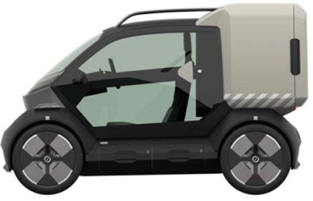
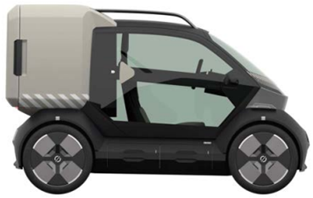
Pattern "" is provided in the center of each wheel
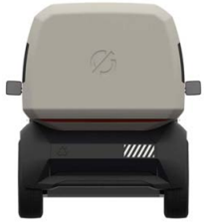
Pattern "" is provided in the center of the rear side of the trunk
In 2022, Human Horizons Holdings (Shanghai) Co., Ltd., as the petitioner, filed a request for invalidation against the design patent owned by the patentee, Renault Kommanditgesellschaft, with the CNIPA, on the grounds that the design patent right conflicts with its prior trademark right.
After examination, the CNIPA made the above Decision on Invalidation.
2. Relevant regulations
Article 23.3 of the Patent Law clearly stipulates that “The design for which a patent right is granted shall not conflict with the legal rights already obtained by others before the application date”.
The "Guidelines for Patent Examination" further specifies that "legal rights include trademark rights", and "the determination of the identity or similarity between the prior trademark and the relevant design contained in the patent shall, in principle, be based on the determination criteria of trademark identity or similarity".
3. Examination and determination of key issues by the panel during the invalidation process
3.1 Determination of whether the pattern of the design patent serves as a trademark
In invalidation cases in which a design patent right conflicts with a prior trademark right, it is usually necessary to determine whether the use of relevant patterns of the design patent is in the sense of a trademark, that is, whether the pattern has the function of distinguishing the source of goods or services. As for this invalidation case, in the design patent, the pattern "" is provided in the center of each wheel (see above figures), which center is the same position as that where the prior trademark is used (see figure below). Also, the pattern "" is provided in the center of the rear side of the trunk (see above figure), which center is also a common location for automobile products to locate trademarks. Therefore, the above patterns of the design patent objectively serve as a trademark.
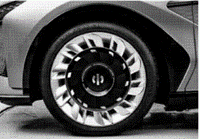
Trademark " " is provided in the center of the wheel
3.2 Determination of whether the pattern of the design patent is similar to the prior trademark
As mentioned above, the determination of the identity or similarity between the prior trademark and the relevant design contained in the patent shall, in principle, be based on the determination criteria of trademark identity or similarity. To be specific, on the one hand, it is necessary to determine whether the product protected by the design patent is the same as or similar to the goods on which the prior trademark is designated to be used. On the other hand, based on the general attention and cognitive ability of the relevant public, it is necessary to determine whether the pattern of the design patent is the same as or similar to the prior trademark. At the same time, factors such as the distinctiveness and the popularity of the prior trademark need to be considered when determining whether the pattern of the design patent makes the relevant public easily confuse the sources of the goods or services.
The products relating to both the design patent and the prior trademark in this invalidation case are automobiles. The focus is on whether the pattern of the design patent and the prior trademark are similar. Comparing the above pattern of the design patent with the prior trademark, the similarities between the two lie in that: they are formed by two symmetrical arcs in shape of a pair of parentheses, with a line segment set between the arcs, and the upper and lower ends of the line segment exceeding the gap between the arcs. The main differences between the two lie in that: (1) the prior trademark "" is perpendicular to the horizontal line on the ground, while the patterns "" and "" of the design patent are inclined at a 45 degree angle relative to the horizontal line on the ground; (2) the two arcs of the design patent are slightly longer than those of the prior trademark; (3) the two ends of the line segment in the design patent are straight, while the two ends of the line segment in the prior trademark are slightly chamfered. In this regard, the panel believes that determination of identity or similarity between trademarks should be based on the general attention of the relevant public. According to this, the panel deems that the above pattern of the design patent is basically the same as the prior trademark, both giving the relevant public an overall visual impression that a line segment is centered between a pair of arcs.
For the above difference (1), the panel holds that it is difficult for the relevant public to identify the angle difference between the pattern of the design patent and the prior trademark in actual use due to the following reasons:
a) The angle of the pattern of the design patent relative to the horizontal line on the ground varies when the automobile runs and is also random when the automobile stops, and thus when the automobile stops at a certain time, the angle of the pattern of the design patent is the same as that of the prior trademark.
b) For each pattern, the angle of the pattern relative to the horizontal line on the ground also varies depending on the different perspectives of the relevant public. For example, as shown in the following figures of Evidence 4 and Evidence 9, the photos taken from the side show that the prior trademark also has an oblique angle relative to the horizontal line on the ground.

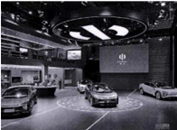
Figure of Evidence 4 Figure of Evidence 9
For the above differences (2) and (3), the panel points out that such differences are so subtle that the relevant public can hardly notice them with general attention based on the following reasons:
a) The length of the arcs of the design patent is different from that of the prior trademark, but each of the two pairs of arcs are generally similar to parentheses.
b) The chamber of the two ends of the line segment in the design patent is slightly different from that of the two ends of the line segment in the prior trademark, but the two line segments are generally similar to long bars.
Therefore, the above pattern of the design patent is similar to the prior trademark.
3.3 Examination of allegation and disproof of the patentee
In this invalidation case, the petitioner submitted many online evidences to prove the popularity of the prior trademark, while the patentee submitted a foreign judgment to prove that the prior trademark has no distinctive characteristics and also submitted domestic administrative decisions and other automobile trademarks to prove that the pattern of the design patent is not similar to the prior trademark. Therefore, the panel also commented on the allegation and disproof of the patentee one by one.
3.3.1 Can foreign judgments prove that the prior trademark has no distinctive characteristics?
The foreign judgment submitted by the patentee states that the registered trademark "" of the petitioner should not have a broad protection scope due to its small difference from the well-known standby icon " " and its weak distinctiveness.
In this regard, the panel believes that: firstly, the foreign judgment has no binding force on this invalidation case in China since both design patent and trademark rights have regional characteristics, and the judgment also recognizes that "" and "" are very similar; secondly, Evidence 4 provided by the petitioner gives a detailed explanation of “the meaning of the HiPhi logo":
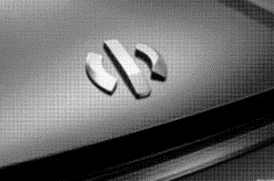
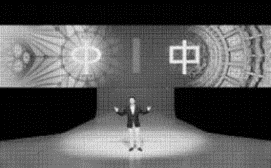
Figure of Evidence 4 Figure of Evidence 4
The new logo adopted by HiPhi combines the golden ratio principle ‘Φ’ discovered by Western philosophers with the Chinese character '中' representing the essence of Chinese ideology, to form a perfect geometric figure. The logo represents a world that is 'integrated' but different, and shows the brand spirit and vision of HiPhi. It can be seen that the original design intention of the prior trademark '' is not related to the standby icon '', and the pattern of the design patent and its meaning are totally different from those of the prior trademark. Finally, the prior trademark "" already has the function of clearly indicating the source of goods or services after a widely promotion and use the petitioner. The relevant public has already linked the automobile using the prior trademark "" with the petitioner or believes that the automobiles using the prior trademark "" have a specific connection with the petitioner. Therefore, the allegation by the patentee that the prior trademark "" has no distinctive characteristics is not valid.
3.3.2 Can domestic administrative decisions prove that the pattern of the design patent is not similar to the prior trademark?
The patentee submitted a Decision of Rejection on No. 60136328 trademark application for "" designated on products such as "automobiles, land motor vehicles", and based on the Decision of Rejection alleged that the pattern "" is not similar to the prior trademark "" since the CNIPA cited registered trademarks No. 6859132 " " and No. 9303738 "
 ", rather than the prior trademark "" of the petitioner, in the Decision of Rejection.
In this regard, the panel believes that the Decision of Rejection not citing the petitioner’s prior trademark "" cannot prove that the pattern of the design patent is not similar to the prior trademark and gives the following reasons: on the one hand, the CNIPA has rejected the trademark application "" on "automobile" of Renault Kommanditgesellschaft, which proves that the use of "" trademark on automobile products without permission will infringe the right to the cited trademarks; on the other hand, the CNIPA can on its own initiative choose to terminate the search when similar trademarks have been retrieved.
3.3.3 Can other automobile trademarks prove that the pattern of the design patent is not similar to the prior trademark?
The patentee alleges that in the automobile field relevant to the design patent, for the relevant public has strong attention and recognition ability during purchase or use since automobiles are common large goods in daily life. The patentee also listed some graphic trademarks in the automobile field, and pointed out that the implementation of the design patent will not mislead the relevant public or cause confusion to the relevant public.
In this regard, the panel deems that the graphic trademarks listed by the patentee in the automobile field are not related to this case, and the determination of similarity between trademarks adopts the case-by-case principle. For graphic trademarks, it is necessary to consider various factors such as the pattern and actual use status of the trademark, along with popularity and influence of the trademark brought about by widespread use. Although the relevant public has a high level of attention and recognition ability when purchasing and using large goods, where the pattern "" of the design patent is very similar to the prior trademark "", it can still mislead the relevant public or cause confusion about the source of the goods.
When filing a design application, the applicant involved should follow the principle of good faith, respect and reasonably avoid the prior trademark rights of others, in order to prevent conflicts with the prior trademark rights. The applicant's prior trademark "
" was filed on August 20, 2018, approved for registration in the automobile category on December 7, 2019, and has been widely used since 2019. The patentee should be aware of the applicant's prior trademark "". The application date of the design patent is June 11, 2021, which is later than the registration date of the prior trademark. The patentee failed to fulfill appropriate obligations of care, resulting in a conflict between the design patent and the prior trademark rights, and thus should bear adverse consequences.
In summary, the design patent, without the permission of the petitioner, uses patterns similar to the prior trademark in the same locations of the same class of goods or in the locations where the trademark is usually placed, which can easily confuse the relevant public with the source of the corresponding goods. Therefore, the design patent conflicts with the prior trademark and does not comply with the provisions of Article 23 (3) of the Patent Law.
4. Typical significance and inspiration
In brief, this invalidation case, on one hand, gives a guidance to the examiners to handle conflicts between a design patent and a prior trademark, and on the other hand, reminders the enterprises to protect the intellectual property in various ways and reasonably avoid prior legal rights of others.

点击右上角
分享给朋友吧







 Long by picture save/share
Contact Us
Address:Room 716, Gaode Tower, 10 Huayuan East Road, Haidian District, Beijing
Postcode:100083
Tel: 86-10-62966619
Website: www.ipmarch.cn
Email:mail@ipmarch.cn



点击右上角
分享给朋友吧
Contact Us
Address:Room 716, Gaode Building, 10 East Huayuan Road Haidian District, Beijing
Postcode:100083
Tel: 86-10-62966619
Website:www.ipmarch.cn
Email:mail@ipmarch.cn
